
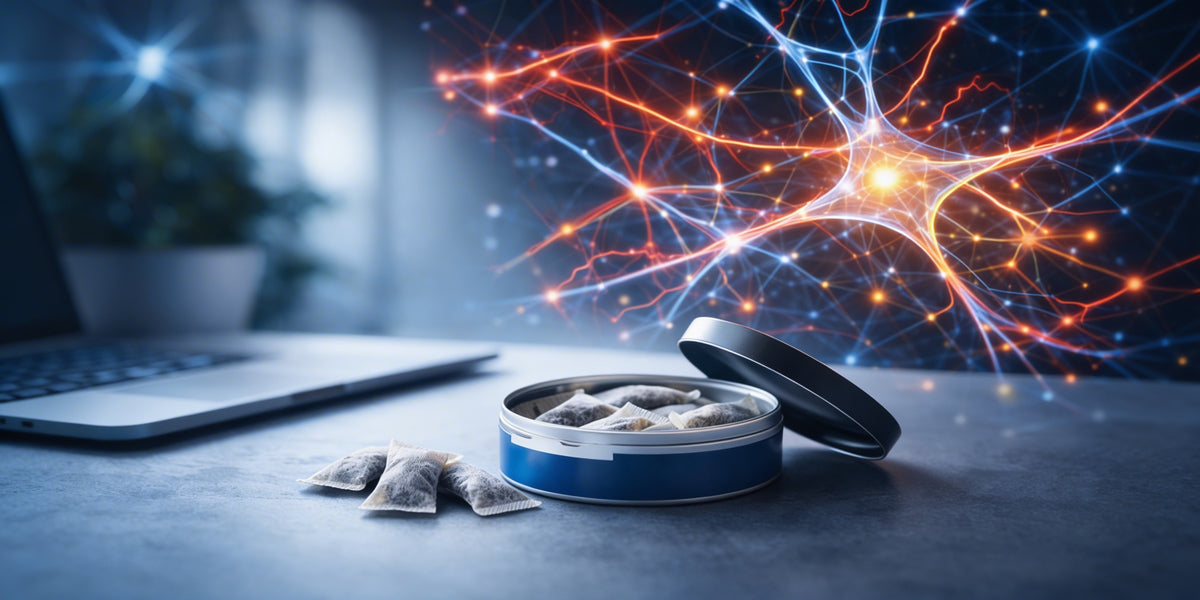
Stress is a part of everyday life for many people. Professional demands, time pressure, or personal burdens lead to seeking brief moments of relief. In this context, the effect of Snus on stress comes into focus. Some users report that they deliberately reach for Snus in tense situations to gain mental distance.
The desire for a "small moment" of calm is central here. Snus is perceived as a discreet, smoke-free option that can be easily integrated into the daily routine. But what mechanisms underlie this subjective impression, and where are the limits? An objective look at biological and psychological connections helps to realistically assess the effects.
What happens in the body when using Snus?
When consumed, nicotine is absorbed through the oral mucosa. Within minutes, it enters the bloodstream and reaches the central nervous system. There, it binds to nicotinic acetylcholine receptors and influences the release of various neurotransmitters, including dopamine. This is part of the reward system and plays a role in motivation, attention, and behavior control.
At the same time, the sympathetic nervous system can be activated. Heart rate and blood pressure temporarily increase, and adrenaline is released. How strongly these effects are perceived depends, among other things, on the amount of nicotine absorbed.
If you want to explore this in more detail, how much nicotine a Snus contains is explained in detail in the Snushus blog.
It is important to consider the timing: The described changes are temporary. As the nicotine level drops, the activation also decreases. Snus is not a medical or therapeutic solution for chronic stress or mental illnesses. In cases of ongoing strain, structural measures or professional support are recommended.
Snus and stress: Short-term effects and possible long-term consequences
In connection with stress, nicotine use is sometimes described as relieving. It should be noted that it is a psychoactive substance with stimulating properties. A short-term change in subjective well-being does not automatically mean an actual reduction of stress in the medical sense.
With regular use, another mechanism can also play a role. When nicotine levels drop, initial withdrawal symptoms may appear, such as inner restlessness or irritability. When nicotine is taken again, these sensations are alleviated. The effect perceived as "relaxation" can thus partly consist of neutralizing emerging withdrawal symptoms.
In the long term, tolerance can develop. Higher amounts are then needed for the same subjective effect. This habituation effect can cause the initially perceived support to lose intensity. At the same time, the risk of dependence increases.
Short-term changes in stress perception after nicotine consumption
Nicotine can show different phases of effect. Shortly after intake, some users report increased alertness or improved concentration. The release of dopamine and noradrenaline can enhance attention and influence responsiveness.
At the same time, some users describe a subjective feeling of calm. This apparent contradiction can be explained by the complex interaction of various neurotransmitters. Especially with regular use, stabilizing a falling nicotine level can be perceived as relief.
The key point remains: These effects are temporary and vary individually. Sustainable strategies for stress regulation are not replaced by this.
Long-term use and its consequences: Nicotine tolerance and dependence
With repeated use, the nervous system adapts to regular nicotine intake. This adaptation process is called tolerance development. The originally perceived effects may weaken over time.
At the same time, dependence can develop. When nicotine levels drop, withdrawal symptoms such as inner restlessness, irritability, or concentration problems occur. In such moments, renewed use is often experienced as relieving, although primarily the withdrawal state is being eased.
In the long term, this can create a cycle in which nicotine itself becomes a factor influencing stress perception.
Limits and context: Snus in relation to stress
Snus is a nicotine-containing recreational product and not a therapeutic tool for treating chronic stress, anxiety, or other psychological burdens. Short-term changes in well-being do not replace structural adjustments in daily life.
It is important to distinguish between occasional use and regular use as a supposed permanent solution. If nicotine is deliberately used to mask ongoing stress conditions, a problematic dynamic can develop.
Those suffering from chronic stress should focus on analyzing causes and suitable coping strategies. A differentiated view of one’s own consumption behavior, such as regarding amount and frequency, supports responsible use. If you want to explore this further, how much Snus per day is recommended offers an objective guide to consumption patterns and assessment in the Snushus blog.
Using Snus consciously: Clarity about effects and limits
Engaging with the biological and psychological connections shows that nicotine can trigger both activating and subjectively calming effects. These are based on neurobiological processes and are temporary. At the same time, there is a risk of tolerance development and dependence.
Snus is a smoke-free product and differs significantly from tobacco products involving combustion. Nevertheless, nicotine remains a psychoactive substance with physiological effects.
Those who consider Snus as part of a modern, smoke-free lifestyle should be aware of the biological connections and realistically assess the effect of Snus on stress. Informed decisions, reflective consumption behavior, and clarity about personal limits are key prerequisites for self-determined use.
If you want to learn about current products and common varieties, you can find a selection of frequently requested products in the overview of Best Sellers at Snushus. Comparing nicotine content, strength, and format can support a conscious decision.


 Dieses Produkt schädigt Ihre Gesundheit und macht stark abhängig.